

Cannot Sleep, Cannot Recover: Breaking the Pain-Sleep Cycle
by Dr. Kam Mann | |

Cannot Sleep, Cannot Recover: Breaking the Pain-Sleep Cycle
There is a particular kind of exhaustion that sits differently from ordinary tiredness. It is the exhaustion of a body that has been in pain long enough that sleep has become complicated. Where lying down is not relief but another negotiation. Where three in the morning means staring at the ceiling, calculating whether rolling over is worth the consequence.
People in this position rarely describe it as a sleep problem. They describe it as a pain problem. They are right, but only partly. What is actually happening is a cycle. Understanding how that cycle works is the first step toward breaking it.
SALAS Collective Care in South Surrey collective care team is built to hold exactly this kind of complexity. The registered massage therapists and acupuncturists at the clinic see this pattern regularly, and it is one of the most common and most under-explained experiences in chronic pain care.
Why Chronic Pain and Poor Sleep Feed Each Other
Pain and sleep exist in a relationship that most health conversations fail to address honestly. They are not two separate problems that happen to coincide. Pain and sleep are two expressions of the same dysregulated system. Each making the other worse in a loop that can run for months or years without the right intervention.
The mechanism is direct and well-documented. Pain activates the nervous system, keeping it in a state of readiness fundamentally incompatible with the deep, restorative sleep the body needs to repair. When deep sleep is disrupted, the nervous system becomes more sensitive to pain signals the following day. More sensitivity means more pain. More pain means another disrupted night.
Stages of Pain and Sleep Disruption
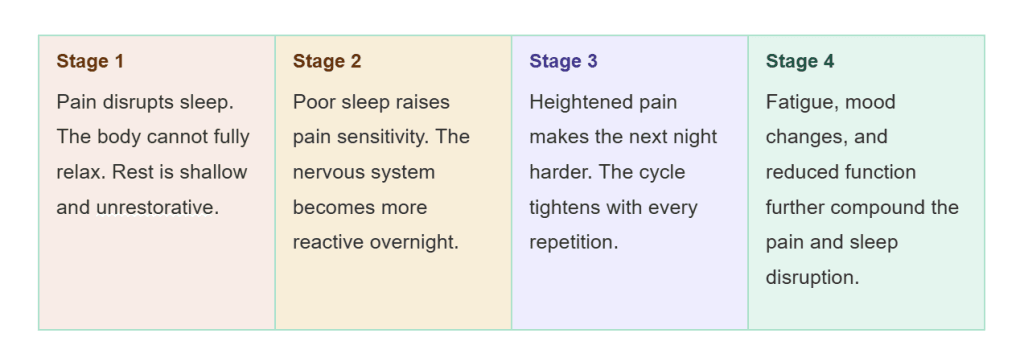
This cycle does not announce itself. It builds quietly. A few bad nights become a week. A week becomes a month. The fatigue can begin to affect mood, concentration, and the ability to manage pain emotionally. The pain starts feeling bigger, not because it has changed, but because the resources to cope with it have been depleted.
Many people living in this cycle have been told to sleep better and manage their pain better, as though these are separate tasks requiring more discipline. They are not. They are two symptoms of the same underlying dysregulation, and they respond best when addressed together.
What Chronic Pain Does to Your Sleep
Sleep is not a single uniform state. It moves through cycles of light sleep, deep sleep, and REM sleep, each serving a different physiological function. Deep sleep is when the body does its most significant repair work: tissue regeneration, immune function, hormonal regulation, and cellular recovery.
Pain, even low-level chronic pain, preferentially disrupts deep sleep. The nervous system, still monitoring for threat, does not allow the descent into the stages where genuine recovery happens. People with chronic pain often spend more time in lighter sleep stages, wake more frequently, and spend less time in the restorative phases that make sleep feel restorative.
The consequences compound over time. Tissue that cannot repair overnight becomes more irritable during the day. Inflammation that is not cleared during sleep accumulates. The pain threshold drops because the nervous system, running on inadequate rest, becomes hypervigilant. Everything hurts more than it should, not because the injury has changed, but because the system processing it is exhausted.
How Pain Disrupts Deep Sleep Stages
Research on sleep and chronic pain shows that pain-related sleep disruption occurs predominantly during the deepest stages of sleep, those associated with physical repair and immune function. This means the hours spent in bed are not translating into the recovery the body needs.
For patients managing conditions like chronic back pain, arthritis, or soft tissue injuries in South Surrey and White Rock, this is often why progress feels so slow. The body is simply not getting the overnight recovery time it needs to heal between days.
Why Pain Sensitivity Worsens Without Sleep
Research on sleep deprivation and pain is consistent and striking. Even one night of poor sleep measurably reduces pain tolerance the following day. After several consecutive disrupted nights, healthy people with no prior pain condition begin reporting pain in previously symptom-free areas.
For someone already managing chronic pain, every poor night actively makes the following day harder. The pain experienced on a well-rested day differs from that after a week of disrupted sleep, even when the underlying condition remains unchanged. This is why chronic pain so often feels unpredictable. The sleep variable is rarely accounted for.
Massage Therapy for Sleep and Chronic Pain Relief
Registered massage therapy addresses the pain-sleep cycle at the nervous system level, not just the tissue level. This distinction matters because treating the tissue alone, without addressing the nervous system state driving both the pain and the disrupted sleep, provides only temporary relief that does not last.
A skilled RMT session activates the parasympathetic nervous system, the branch responsible for rest, recovery, and repair. Cortisol drops. Heart rate settles. The muscles holding a protective contraction around pain begin to receive a different signal. The nervous system begins to understand that, for now, it is safe to let go.
For people in the pain-sleep cycle, this shift in the nervous system is often the most significant thing that happens in the treatment room. Not the release of a specific knot, or the improvement in range of movement, but the global settling of a system that has been running on high alert for far too long.
What the Research Says About RMT and Sleep
Multiple studies have demonstrated that regular massage therapy improves sleep quality in people with chronic pain conditions. The mechanism is partly the reduction in pain intensity and partly the direct effect of therapeutic touch on the autonomic nervous system. Research shows increases in delta wave activity, the brain wave associated with deep sleep, following massage therapy sessions.
The improvements are not limited to the night immediately following a session. Regular RMT over a period of weeks shows cumulative improvement in sleep quality, suggesting the nervous system is gradually recalibrating its baseline state rather than simply relaxing temporarily.
What Consistent RMT Treatment Changes
The pattern most patients describe after consistent RMT treatment is not a dramatic overnight shift. It is a gradual recalibration of the baseline. The pain is still present, but slightly less in the morning. The nights are still disrupted, but less consistently. The three a.m. ceiling-staring becomes occasional rather than nightly.
This recalibration is the body finding its way back to a state where recovery is possible. For patients in South Surrey and White Rock who have been managing the pain-sleep cycle for months or years, this shift, once it begins, is consistent in its direction.
Acupuncture for Chronic Pain and Sleep
Acupuncture and registered massage therapy address the pain-sleep cycle through complementary mechanisms. The combination approach at SALAS Collective Care is one of the most effective available in South Surrey for people who have not found lasting relief with a single discipline alone.
Acupuncture works on the nervous system through a different pathway than massage. It stimulates specific points that influence the autonomic nervous system, the endocrine system, and the body’s pain-regulation mechanisms. For sleep specifically, acupuncture has a direct effect on melatonin production, the hormone that regulates the sleep-wake cycle and is frequently disrupted in people with chronic pain.
How Acupuncture Addresses Pain at Its Source
Chronic pain has both peripheral and central components. The peripheral component is what is happening in the tissue. The central component is how the nervous system processes and amplifies the pain signal. This central sensitization, where the pain system becomes overactive and begins generating pain responses to stimuli that should not cause pain, is one of the most significant drivers of chronic pain that does not respond to local treatment.
Acupuncture is one of the few interventions with evidence for directly addressing central sensitization. Research shows it reduces the activity of pain-processing centres in the brain and modulates the body’s own pain-regulation system, reducing the amplified response that chronic pain generates over time. For people whose pain has become widespread, unpredictable, or sensitive to touch, this central component is often what matters most.
Acupuncture and Sleep: What the Evidence Shows
The evidence for acupuncture and sleep is among the strongest in the complementary medicine research base. Studies consistently show improvements in sleep onset time, total sleep duration, and subjective sleep quality. The mechanisms involve the regulation of serotonin and melatonin, the downregulation of the sympathetic nervous system, and the reduction of nocturnal pain activation that disrupts sleep architecture.
For the patient lying awake at three in the morning because the hip has started aching again, acupuncture is not a gentle wellness option. It is a clinically supported intervention for a specific physiological disruption. Patients at SALAS Collective Care in South Surrey consistently report improvements in both pain levels and sleep quality when acupuncture is part of their care plan.
Signs the Pain-Sleep Cycle Is Driving Your Symptoms
The following patterns are common in people whose pain and sleep have become locked together. Recognizing them is the first step toward understanding what kind of care will actually help.
- Pain that is consistently worse in the morning than when going to sleep
- Waking between two and four in the morning with pain that was not present at bedtime
- Feeling unrefreshed regardless of how many hours were spent in bed
- Pain that seems to spread or become more unpredictable over time
- Mood changes or irritability that feel disproportionate to circumstances
- Pain that responds temporarily to treatment but returns to the same level within days
- A sense that the body is no longer recovering from activity the way it once did
None of these patterns means that something is permanently wrong. They mean the nervous system needs support to exit a cycle it cannot break on its own. That support is available and tailored to each body’s needs.
RMT and Acupuncture at SALAS Collective Care
SALAS Collective Care brings together physiotherapy, chiropractic, registered massage therapy, acupuncture, kinesiology, clinical Pilates, and counselling in one South Surrey clinic. For patients managing the pain-sleep cycle, the combination of RMT and acupuncture within a collaborative team creates an approach that addresses the cycle from multiple directions simultaneously.
The RMT and acupuncture practitioners at SALAS communicate with each other and with the broader team. The treatment plan adapts as the patient’s presentation changes, and progress made in one discipline is reinforced by the work being done in another. Patients do not need to coordinate their own care or explain their situation at every appointment. The team holds that context.
The clinic is located on the first floor of the professional buildings at Semiahmoo Mall in South Surrey, close to Shoppers Drug Mart and LifeLabs, with free parking and easy ground-floor access.
Good care should not be complicated to access. SALAS Collective Care is one space, one team, and one experience designed around the patient, not the system.
Contact SALAS Collective Care in South Surrey – White Rock
Book an appointment online or call the clinic directly. No referral is needed. Direct billing is available through most extended health plans.
Frequently Asked Questions
Can Massage Therapy Help Me Sleep Better?
Yes. Research consistently shows that registered massage therapy improves sleep quality, particularly in people with chronic pain. The mechanism involves both the reduction in pain intensity and the direct activation of the parasympathetic nervous system, which creates the physiological conditions for restorative sleep. Studies show improvements in deep sleep stages following RMT sessions. Book an appointment at SALAS Collective Care in South Surrey online or by calling the clinic.
Why Does My Pain Feel Worse When I Have Not Slept Well?
Sleep deprivation measurably reduces pain tolerance and increases pain sensitivity. This is a well-documented physiological effect. When the nervous system does not receive adequate restorative sleep, it becomes hypervigilant and amplifies pain signals. This is why chronic pain often feels more intense after a run of poor nights, even when the underlying condition has not changed.
Does Acupuncture Help With Sleep and Chronic Pain?
Yes. Acupuncture has strong research support for improving sleep quality, regulating melatonin and serotonin, and reducing central sensitization in chronic pain conditions. Studies show improvements in sleep onset time, total sleep duration, and pain levels following treatment. The SALAS Collective Care acupuncture team in South Surrey works alongside the RMT team for patients managing both pain and sleep disruption.
How Many Sessions Does It Take to Improve Sleep and Pain?
Most patients begin to notice shifts in sleep quality within three to five RMT or acupuncture sessions. Consistent treatment over six to twelve weeks typically produces more sustained change, as the nervous system gradually recalibrates rather than simply relaxing for a single session. The SALAS team builds a treatment plan based on each patient’s specific presentation and adjusts as progress develops.
Do I Need a Referral to Book RMT or Acupuncture at SALAS?
No referral is needed. Appointments can be booked online at salascollectivecare.com or by calling the clinic directly. Direct billing is available through most extended health insurance plans. Contact SALAS Collective Care in South Surrey to confirm coverage before booking.
What Is Central Sensitization and Does It Affect My Pain?
Central sensitization occurs when the central nervous system’s pain-processing mechanisms become overactive after sustained pain input. The system amplifies pain signals and begins producing responses to stimuli that would not normally cause pain. It is one of the reasons chronic pain can spread and become less predictable over time.
Research suggests acupuncture may support pain regulation through neurological pathways, including effects on how the nervous system processes pain signals. The acupuncture practitioners at SALAS Collective Care in South Surrey can speak to whether acupuncture is an appropriate part of a care plan for each individual presentation.